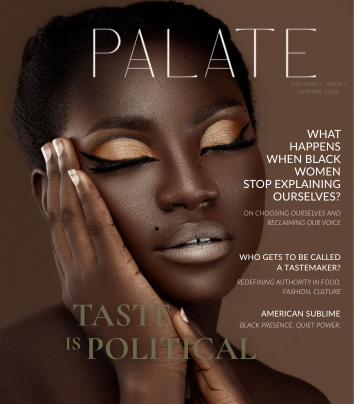


On cultural authority in food, travel, art, and the politics of refinement
The title of tastemaker suggests influence and discernment. But in food, travel, art, and fashion, the power to define what is good is rarely neutral. Behind every declaration of what matters lies a system of validation — and a history of who has been permitted to speak for culture.
At a gallery opening, a restaurant debut, or the unveiling of a new “must-visit” destination, the word tastemaker often appears as shorthand for authority. It suggests discernment. Influence. Cultural fluency. But beneath its polished surface lies a quieter question: who is granted the power to define what is good?
The designation of tastemaker is not merely descriptive. It is gatekeeping.
Taste is rarely neutral. It is shaped by proximity to institutions, capital, media platforms, and networks that determine which voices are amplified and which remain peripheral. A chef becomes visionary when validated by critics with established reputations. An artist becomes essential when a museum acquires their work. A neighborhood becomes “discovered” once it appears in a travel editor’s column. Each declaration carries more than aesthetic judgment — it confers legitimacy.
The designation of tastemaker is not merely descriptive. It is gatekeeping.
In food, certain cuisines are framed as elevated while others are labeled comforting, rustic, or niche. In travel, some cities are positioned as cultural capitals while others are reduced to backdrops. In art, some aesthetics are celebrated as minimal and refined, while others are dismissed as excessive or loud — until they are reinterpreted through a more institutionally acceptable lens. Fashion follows similar patterns. What is considered daring or avant-garde often depends less on the garment itself and more on who is wearing it and who is watching.
This pattern reveals an uncomfortable truth: taste is entangled with power.
To call someone a tastemaker is to acknowledge their authority to shape perception. Their recommendations influence reservations, ticket sales, museum attendance, hotel bookings, and acquisition budgets. Cultural value is not only experienced; it is distributed. And distribution rarely happens evenly.
Yet culture does not originate in boardrooms or press releases. It begins in kitchens, studios, neighborhoods, and communities long before it is curated for mass consumption. The aesthetics that eventually populate museum walls or glossy travel spreads are often rooted in lived experience — shaped by memory, migration, ritual, and resourcefulness. When those origins are obscured, refinement appears detached from its lineage.
The politics of taste emerge in these moments of translation. When something is deemed tasteful, it is not simply being praised; it is being positioned within a hierarchy. The language of minimalism, sophistication, and timelessness can quietly reinforce narrow definitions of beauty and worth. Meanwhile, expressions that fall outside those definitions may be described as trend-driven, niche, or emerging — regardless of their longevity or influence.
To interrogate who gets to be called a tastemaker is not to dismiss discernment. Discernment matters. Curation matters. Expertise matters. The question is whose expertise has historically been recognized and whose has been overlooked.
The expansion of digital platforms has shifted this landscape, allowing new voices to shape conversations around food, travel, art, and design. But even in decentralized spaces, hierarchies reconstitute themselves. Visibility can still depend on algorithms, sponsorship, or access to networks that mirror older institutions.
Perhaps the more generative reframing is this: taste need not be a fixed badge granted by gatekeepers. It can be understood as practice — the ongoing cultivation of attention. The ability to see nuance in a neighborhood long before it trends. To recognize artistry in a dish without waiting for a star. To value a destination for its lived rhythms rather than its social media aesthetics. To engage with art not because it has been validated, but because it resonates.
When taste is reclaimed as discernment rather than status, the idea of the tastemaker begins to shift. Authority becomes less about proximity to power and more about clarity of vision. Less about naming what others should admire, and more about expanding the range of what is seen as worthy.
What is called ‘discovered’ has often existed in plain sight.
The question remains: who gets to be called a tastemaker?
The answer, increasingly, may depend on who refuses to wait for permission to define what matters.
To interrogate who gets to be called a tastemaker is not to reject discernment. It is to examine how discernment is assigned, circulated, and protected. Authority in culture has often depended on access — to institutions, media platforms, capital, and social proximity. Those conditions shape not only what is elevated, but what is overlooked.
The more urgent question may not be who holds the title, but who has been excluded from it. When refinement is defined narrowly, entire traditions are rendered peripheral until validated by a familiar gatekeeper. What is called “discovered” has often existed in plain sight.
Taste, at its most powerful, is not about endorsement. It is about attention. It is the discipline of noticing what others ignore, the willingness to recognize value before it is sanctioned, the refusal to confuse popularity with depth.
Perhaps the future of the tastemaker is less about coronation and more about expansion — widening the frame of what counts as sophisticated, worthy, and culturally significant.
The title matters less than the naming.
And the naming, increasingly, belongs to those who understand that culture has never been neutral — only curated.