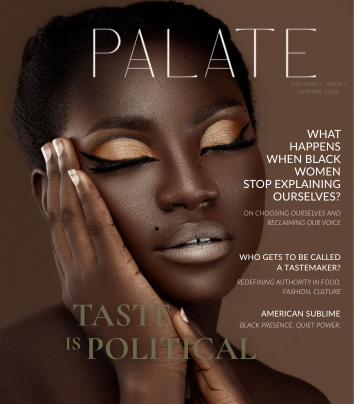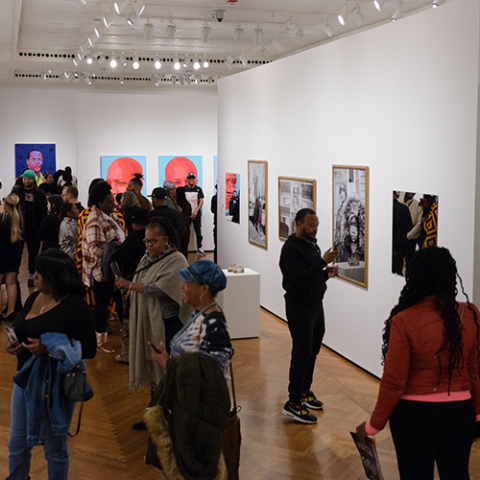

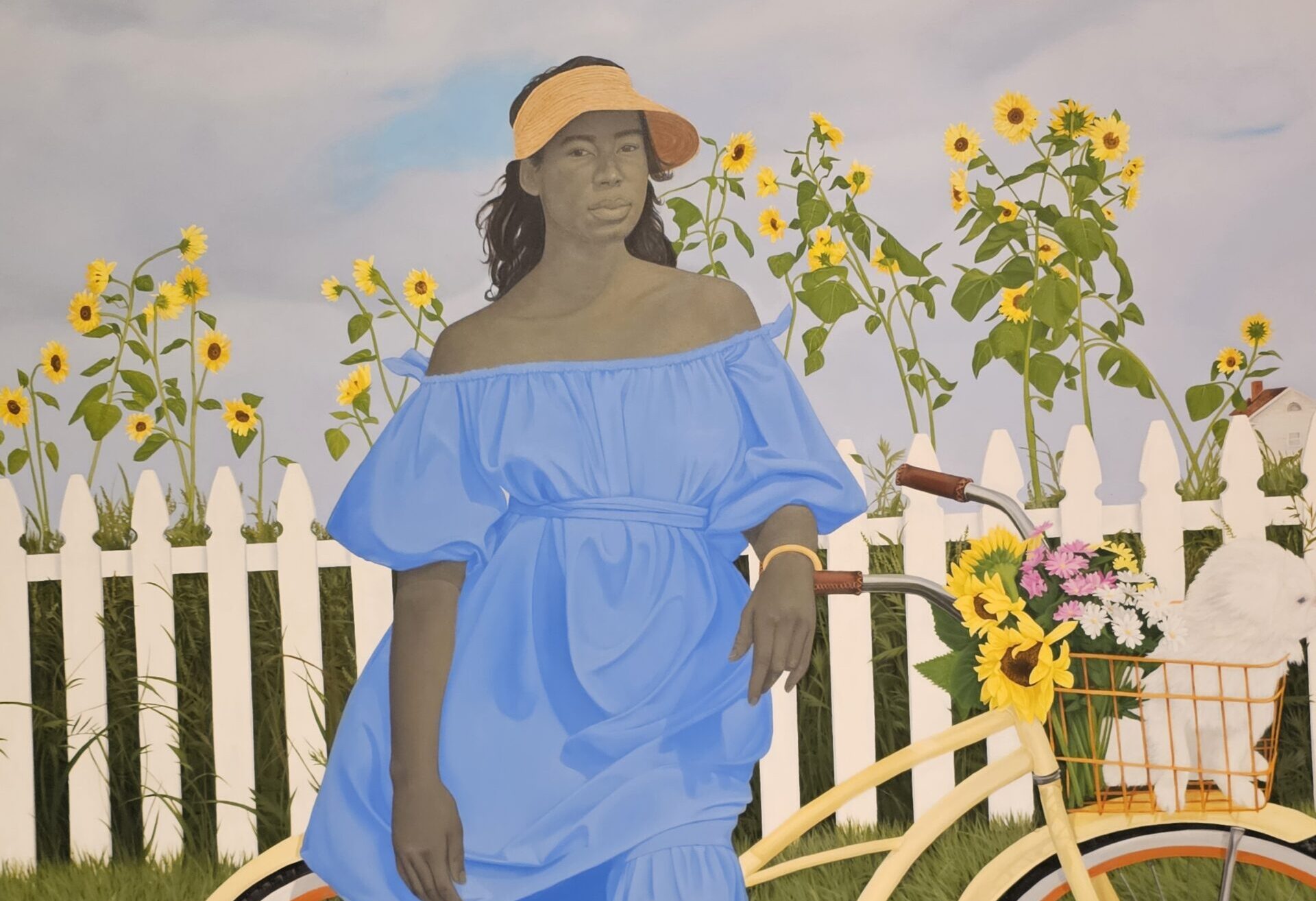
American Sublime is currently on display at Baltimore Museum of Art until April 5, 2026.
In an art world that has long demanded spectacle from Black subjects, Amy Sherald has built a career on refusal. Her paintings do not perform trauma, nor do they contort Black life into legibility for a presumed outside gaze. Instead, Sherald offers something quieter—and far more radical: images of Black Americans simply existing, self-possessed and unhurried, rendered with clarity, restraint, and care.

Her exhibition American Sublime gathers this vision into a cohesive statement. Across its canvases, Sherald’s signature figures—posed, composed, and unmistakably present—invite sustained looking. They do not ask to be decoded. They insist on being seen.
A Practice Rooted in Portraiture—and Resistance
Born in Columbus, Georgia, and now based in New Jersey, Sherald emerged within a contemporary tradition of portraiture while deliberately unsettling its conventions. She received national recognition in 2016 after winning the Outwin Boochever Portrait Competition from the National Portrait Gallery, a turning point that accelerated the visibility of her practice. Two years later, her portrait of former First Lady Michelle Obama cemented her place in the cultural imagination—yet the work that followed has been just as rigorous, if quieter in its ambitions.
Sherald’s figures are painted with grayscale skin tones, a formal decision that has become central to how her work is understood. This choice is neither abstraction nor erasure. Rather, it operates as a conceptual strategy—one that removes race from the realm of immediate visual coding while refusing to relinquish Blackness as lived reality. By doing so, Sherald denies viewers the easy shorthand through which Black bodies are so often read, categorized, and consumed.
The result is not distance, but focus.
The Meaning of the Sublime
The term “sublime” has a long philosophical history, often associated with awe, vastness, and transcendence. In American Sublime, Sherald reclaims the concept for Black American life—specifically for moments that have rarely been afforded that designation. Leisure. Contemplation. Confidence. Ease.
Her subjects are dressed with intention but not extravagance. Their clothing—polka dots, stripes, tailored jackets, simple dresses—signals individuality without distraction. Their postures are calm, frontal, and assured. Eyes meet the viewer’s gaze without challenge or submission. These are portraits of autonomy.
Sherald’s compositions resist urgency. There is no narrative climax embedded in the image, no implied before or after. This suspension of action is deliberate. It denies the viewer the comfort of resolution and instead offers presence as its own reward.
Black Life, Unapologetic and Without Explanation
What American Sublime makes clear is Sherald’s commitment to Black interiority. These works are not arguments; they are declarations. They do not attempt to educate the viewer about Black experience, nor do they soften themselves for accessibility. The paintings assume that Black life—ordinary, thoughtful, dignified—is already worthy of attention.
In this way, Sherald’s work exists in conversation with a broader movement among contemporary Black artists who are reshaping representation by narrowing the frame rather than expanding it. The political force of her paintings lies in what they withhold: motion, drama, and spectacle. What remains is agency.
Craft, Control, and Collecting
Technically, Sherald’s work demonstrates discipline. Her surfaces are smooth, her color palettes intentional, her compositions exacting. There is a clarity to her practice that rewards repeated viewing—a hallmark of work that endures beyond its moment of recognition.
For collectors, American Sublime offers a case study in why contemporary Black portraiture has become such a significant site of both cultural and market interest. Sherald’s paintings operate at the intersection of formal rigor and cultural relevance, a combination that has drawn sustained institutional attention.
But collecting art—particularly work by Black artists—is not only about market signals. It is about discernment: understanding an artist’s practice, recognizing coherence over time, and appreciating how form and concept work together.
This is where education matters.
Learning to Look With Intention
For readers encountering Sherald’s work and wondering how to deepen their engagement—whether as viewers, supporters, or collectors—PALATE’s A Black Girl’s Guide to Art Collecting provides a thoughtful entry point. The guide demystifies the collecting process while centering Black women as cultural stewards, not newcomers seeking permission.
It encourages looking before buying. Asking questions. Supporting artists intentionally. Thinking in terms of legacy rather than accumulation. These principles align seamlessly with Sherald’s own practice, which privileges longevity over immediacy.
Why American Sublime Matters Now
At a moment when Black visibility is often demanded loudly and quickly, American Sublime slows the pace. It reminds viewers that representation does not have to be exhaustive to be powerful. That stillness can be a form of resistance. That beauty does not require explanation.
Sherald’s paintings insist that Black Americans deserve to be rendered with care—on their own terms, in their own time. The exhibition does not ask viewers to marvel at exceptionality. It asks them to respect presence.
That distinction matters.
For those committed to understanding contemporary Black art beyond the surface—to collecting it, writing about it, and preserving it—American Sublime offers both a model and a challenge: to look longer, choose carefully, and value the quiet authority of work that knows exactly what it is doing.
Download PALATE’s A Black Girl’s Guide to Art Collecting to continue that work—with discernment, clarity, and intention.