
How to Look, Learn, and Collect With Intention—From First Purchase to Legacy
For Black women, art collecting has never been simply about acquisition. It has always been about recognition—of ourselves, our histories, our aesthetics, and our authority to decide what is worthy of preservation.
Long before auction houses and blue-chip galleries took notice, Black women were already collectors. We filled our homes with images that affirmed us, supported artists within our communities, and documented cultural memory when institutions would not. What has changed is not our instinct to collect, but the visibility—and legitimacy—granted to that instinct by the mainstream art world.
Today, as Black artists command unprecedented attention and prices soar, many Black women find themselves asking how to enter the art market intentionally, without intimidation or excess. Art collecting, despite its reputation, is not reserved for the wealthy or the credentialed. It is a practice—one sharpened through looking, learning, and trusting one’s discernment.
Start With Looking, Not Buying
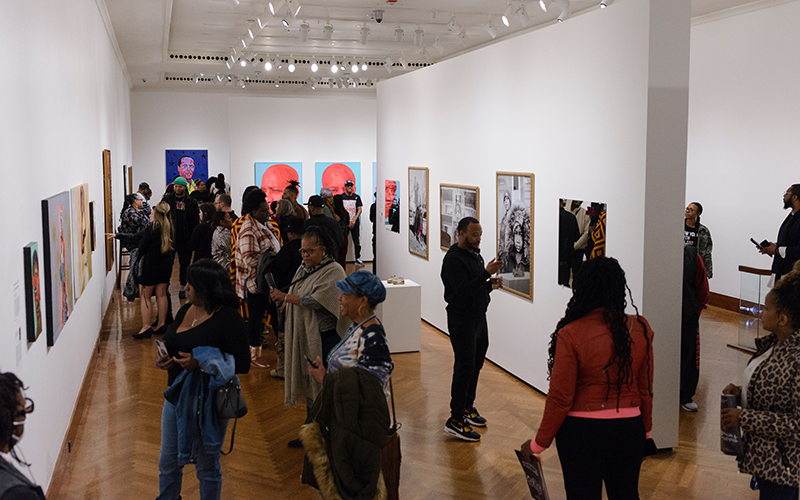
The most important skill a collector can develop is not negotiation, but attention. Before spending money, spend time. Visit museums, galleries, art fairs, and open studios. Look widely and repeatedly. Notice what draws you in—and why. Is it subject matter? Scale? Color? Texture? Political resonance? Emotional clarity?
Taste in art, like taste in food, develops through exposure and comparison. The more you see, the more specific your preferences become. Resist the pressure to buy quickly, especially early on. A collection built too fast often reflects trend rather than conviction.
Learn the Language Without Worshipping It
Art comes with its own vocabulary—medium, edition, provenance, condition, primary vs. secondary market. Learning these terms empowers collectors, but they are tools, not commandments. No degree or insider access is required to appreciate or acquire meaningful work.
Ask questions freely. Reputable galleries welcome curiosity. A collector who understands how an artwork was made, how many editions exist, and where it fits within an artist’s practice is better equipped to collect responsibly and sustainably.
Buy What You Can Live With
A simple rule governs all good collections: if the artist never becomes famous, would you still want to live with the work?
Art should be lived with, not stored solely for speculation. Especially for Black women collectors, the home has often been the first gallery—a site of affirmation and beauty. Collecting work that resonates daily creates a relationship with the art that outlasts market fluctuations.
This does not mean ignoring value. It means refusing to let value be defined only by external validation.
Support Artists Early—and Often
One of the most impactful ways to collect is by supporting artists at early or mid-career stages. This is often where Black women collectors wield the most influence. Buying directly from artists, emerging galleries, or at smaller fairs builds relationships and contributes to sustainable creative ecosystems.
Early support is not charity. It is investment—cultural, emotional, and sometimes financial.
Think in Terms of Legacy
A collection tells a story over time. Consider what narrative your collection holds. Does it center Black interiority? Political critique? Abstraction? Diasporic connection? Generational dialogue?
Legacy collecting asks: What will this body of work say when viewed together? Even a modest collection can be coherent, intentional, and historically meaningful.
Black-Owned & Black-Led Galleries on the East Coast
A Starting Point for Collectors
The following galleries are respected spaces that have played critical roles in supporting Black artists and collectors. This list is not exhaustive, but it is reliable.
- Galerie Myrtis (Baltimore, MD)
A cornerstone of contemporary Black art, representing established and emerging artists with curatorial rigor. - Jenkins Johnson Gallery (New York, NY)
A leading Black-owned gallery with a national footprint, known for scholarship, legacy artists, and institutional impact. - Richard Beavers Gallery (Brooklyn, NY)
A dynamic space focused on emerging and mid-career artists of the African diaspora. - Morton Fine Art (Washington, DC)
A gallery with a strong emphasis on Black figurative work, photography, and narrative depth. - NoName Gallery (Philadelphia, PA)
A thoughtfully curated gallery dedicated to elevating contemporary artists of the African diaspora, with a focus on accessible collecting, community engagement, and cultivating new audiences without sacrificing rigor. - Overdue Recognition (Bowie, MD)
A gallery committed to amplifying artists who have been historically overlooked, pairing strong figurative and narrative work with an explicit mission of cultural preservation and intergenerational visibility.
These spaces are not only places to purchase art, but places to learn—through conversations, openings, and community.
Collect Slowly. Collect Honestly.
Art collecting is not about keeping up. It is about standing firm in one’s taste. For Black women especially, collecting is an assertion of presence: we were here, we saw clearly, and we chose to preserve what mattered.
That is not trend participation.
That is cultural stewardship.