
Policy, power, and the body in a democratic moment
Politics is rarely abstract for those whose bodies are subject to policy decisions long before the ink dries on legislation. Access to healthcare, the right to travel without scrutiny, economic opportunity, and the freedom to define one’s own body and beauty have always been shaped by systems of power. For Black women — who have navigated centuries of exclusion, marginalization, and governance of the flesh — politics intersects with every facet of daily life, from ballot box to bathroom mirror.
Voting measures who participates in governance. Laws about reproductive rights determine who can access care. Workplace protections dictate whose body can earn without penalty. These are not corridors of power far removed from lived experience; they are the environments that envelope life’s most intimate decisions.
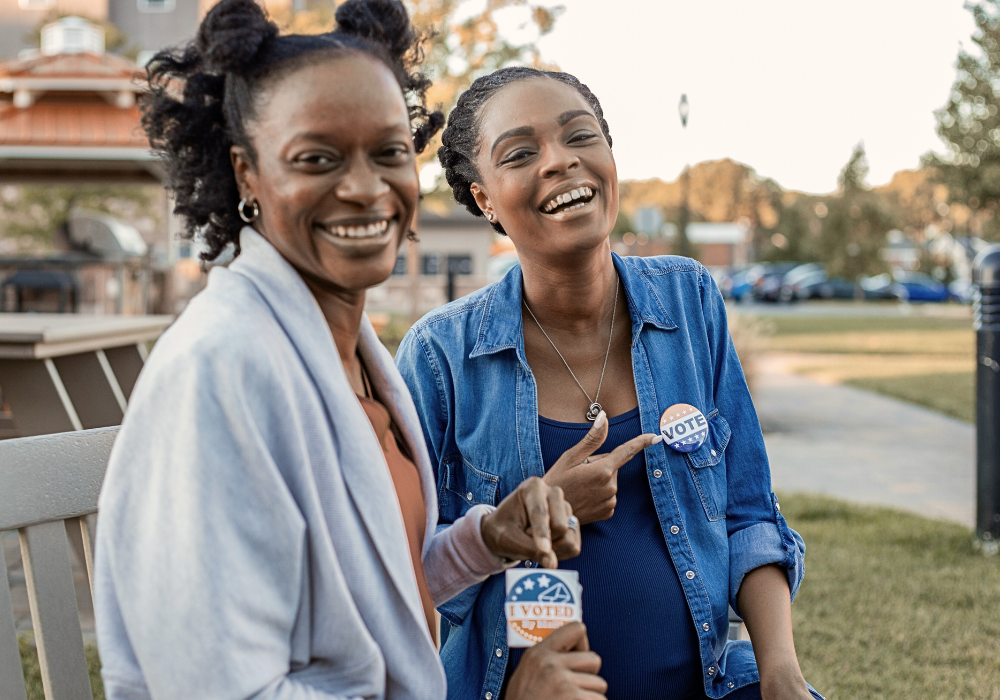
The appointment of public officials, the crafting of healthcare legislation, the distribution of community resources — each has downstream effects on bodily autonomy. This is what Vice President Kamala Harris encapsulated when she reminded voters that “Your vote is your voice, and your voice is your power. Don’t let anyone take away your power.” Voting is not symbolic; it is one of the few structured ways communities influence the systems that shape rights and resource allocation.
At the same time, cultural conversations around beauty are never neutral. What is considered “professional,” “polished,” or “refined” has historically been codified by dominant cultural standards, often marginalizing the aesthetics of bodies outside narrow Eurocentric norms. Black women, in particular, have negotiated beauty standards that cast their natural hair, body shapes, and skin tones as “other” — only to later see those same traits appropriated and sanitized for mainstream consumption. The politics of beauty has forced Black women to answer the question Who gets to decide what is beautiful?
Voting is not symbolic. It is one of the few tools available to influence the systems that govern the body. – Vice-President Kamala Harris
This tension shows itself in public life as well. Black women in politics, from Michelle Obama to local leaders across the country, have long confronted heightened scrutiny of their appearance precisely because culture still trains itself to pay attention to Black women’s bodies before it hears their ideas. Yet figures like Obama have shifted the narrative by embracing identities wholly — demonstrating that visibility itself can be resistance.
In arenas of policy and representation, Black women’s voices have been both indispensable and undervalued. The history of disenfranchisement, from poll taxes to voter ID laws, has repeatedly targeted communities of color under the guise of neutrality — precisely because the voices of those communities, when mobilized, threaten entrenched inequities. The late Shirley Chisholm, first Black woman elected to the U.S. Congress, famously said, “If they don’t give you a seat at the table, bring a folding chair.” That mandate still echoes in efforts to expand access to the ballot box and policy influence.
Bodily autonomy — the right to make decisions about one’s own body without coercion — is likewise shaped by policy. Black maternal mortality, disproportionate rates of chronic illness, and unequal treatment in medical settings do not arise in a vacuum. They are products of systems that have long undervalued Black bodies. Policy choices about healthcare funding, reproductive rights, environmental regulation, and economic support are choices that directly shape bodily outcomes.
Beauty, autonomy, and politics intersect when policy encounters embodiment. Cultural narratives that elevate certain bodies while marginalizing others don’t exist apart from laws that police those bodies. The labor of Black women — from caregiving and community work to professional participation and political mobilization — has historically been underrecognized in policy language and cultural valuation alike. This neglect unfolds in measurable disparities, and it also lives in the quiet demand for respect and visibility.
The activist Tarana Burke — founder of the #MeToo movement — affirms that “You deserve safety. You deserve protection. You deserve love. You deserve peace.” Her words name the stakes of autonomy: not merely choice, but the right to exist without harm, without constraint, without conditional acceptance.
Policy that shapes the body shapes opportunity. Voting that influences policy shapes the terrain of autonomy. When political power shifts at the ballot box, the public structures that shape health, mobility, economic security, and dignity shift with it. To participate in democratic processes is to stake a claim on the structures that either uphold or hinder bodily sovereignty.
The connection between voting and autonomy also reframes beauty from a private ideal to a public proposition. Beauty is political when it becomes a standard that dictates access — from employment opportunities to representation in cultural institutions. The right to define one’s own aesthetics is a dimension of autonomy, not a trivial ornament.
Beauty becomes political when access and safety are unevenly distributed.
When politics determines whose bodies are protected, whose are scrutinized, and whose are made vulnerable, it lays bare that policy is rarely abstract. It is personal, corporeal, and — for many — the arena through which survival and dignity are negotiated.
The task of shaping a society in which all people have equitable access to autonomy, safety, and recognition will always be unfinished. But acknowledging how voting, beauty, and bodily autonomy are interlinked is a necessary foundation for that work. It reframes the public from passive recipients to active participants in the systems that circle closest to life’s most intimate conditions.