

On unhurried travel, self-trust, and why Black women deserve rest without justification
There is a particular kind of exhaustion that clings to Black women. It is inherited. It is cultural. It is professional. It is spiritual. It is the bone-deep fatigue of being hyper-competent in rooms that would collapse without you — and still being asked to prove yourself.
We are praised for being strong. We are admired for being resilient. We are applauded for juggling careers, caregiving, activism, ambition, and impeccable taste. We make it look easy.
It is not easy.
And so the radical act is not doing more.
It is moving slowly.
Not lazily.
Not carelessly.
Slowly.
There is a difference.
Fast Is Performative Action
Modern travel has become an Olympic sport. Three cities in five days. A color-coded Google doc. A “Top 27 Things You Must See Before You Die” itinerary. Dinner reservations booked six months in advance. Outfits scheduled. Photos pre-conceptualized. Content captured before the appetizer arrives.
It’s giving Amazing Race: Burnout Edition.
Even rest has become productive. If we’re going to “unplug,” we must journal, detox, optimize our circadian rhythm, drink chlorophyll, and return home transformed.
What if we didn’t?
What if travel was not about maximizing experience, but about expanding time?
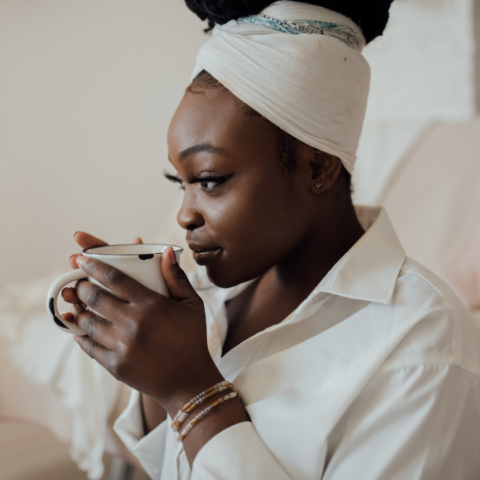
Unhurried travel is not about luxury in the champagne-and-private-jet sense (though, respectfully, we will not decline those). It is about spaciousness. It is about walking without destination. It is about sitting in a café in Lisbon or Cartagena or Charleston and ordering one more coffee simply because you can.
It is about not needing to post until you’re ready.
Or not posting at all.
That is luxury.
Slowness as Self-Trust
To move slowly requires something we are rarely encouraged to cultivate: self-trust.
Black women are conditioned to anticipate. To scan the room. To prepare for the pivot. To outperform expectations before they are voiced. We plan because planning protects us.
Slow travel dismantles that instinct.
When you wander a neighborhood without a checklist, you are trusting your curiosity. When you decline a tour because your body says, “No, let’s stay in,” you are trusting your intuition. When you take the long route home simply because the light is good and your spirit feels open, you are trusting yourself.
Self-trust is not loud. It does not announce itself on Instagram Stories. It whispers: You can choose ease.
This is particularly potent for Black women, who are often denied softness in both public imagination and private life. We are cast as the backbone, the matriarch, the fixer, the one who “holds it down.” Rarely are we cast as the woman reclining by the sea at 2:17 p.m. on a Tuesday, reading a novel she may not even finish.
And yet — we deserve to be her.
The Body Remembers Hurry
Hurry lodges itself in the body. It seeps into the marrow and burrows itself into the recesses of the brain.
It shows up in clenched jaws and shallow breath. In the reflex to check email before sunrise. In the inability to sit still without feeling vaguely guilty. In the way we apologize for taking up space, even on vacation.
I once watched a woman on a beach in Mexico answer work emails between sunscreen applications. She was negotiating a contract while her children built a sandcastle three feet away. The ocean was performing a masterpiece and she was hunched over her phone like it might disappear.
I recognized her.
I have been her.
The world tells Black women that rest must be earned — after the project is complete, after the bills are paid, after the family is tended to, after the community is supported. Rest becomes a reward rather than a right.
But the body does not operate on corporate logic. It does not understand quarterly goals. It understands rhythm. It understands breath. It understands stillness.
When we move slowly — when we truly allow ourselves to — the nervous system recalibrates. The shoulders drop. The appetite returns. The laugh deepens. The sleep becomes honest.
You do not have to justify that.
Unhurried Travel Is Political
There is a quiet politics to choosing slowness.
For centuries, Black bodies were forced to labor without pause. Productivity was extracted. Rest was rationed. Even today, statistics show Black women are among the most educated and yet among the most underpaid demographics in the United States. We are overrepresented in caretaking roles and underrepresented in environments that protect our ease.
So when a Black woman chooses to linger — to stretch a meal into three hours, to nap in the middle of the day, to book the extra night simply because she doesn’t feel like rushing home — she is disrupting a narrative.
She is saying: I am not here solely to produce.
She is saying: My life is not a hustle reel.
She is saying: I can be still and still be worthy.
This is not indulgence. It is reclamation.
The Myth of the “Strong Black Woman”
Pop culture has given us many versions of ourselves. The ride-or-die. The boss. The fixer. The woman who solves everyone’s problems while wearing flawless lip gloss. (We love her. She is iconic.)
But the “Strong Black Woman” trope has a shadow side. It suggests that vulnerability is weakness. That exhaustion is failure. That asking for help is optional.
Moving slowly interrupts that script.
When you take a long bath in your hotel room and ignore your phone, you are refusing the expectation of constant availability. When you book the spa treatment instead of squeezing in another museum, you are honoring your body over your itinerary. When you tell your travel companions, “I’m staying in tonight,” you are choosing yourself without apology.
There is a particular power in that sentence: I’m staying in tonight.
No explanation.
No guilt.
No performance.
Just choice.
A Different Kind of Luxury
We often define luxury through material markers: five-star hotels, first-class seats, designer luggage that glides effortlessly across marble floors. And yes — those things are lovely.
But true luxury is time unclaimed.
It is waking up without an alarm. It is ordering room service at 11 a.m. because you are still in the robe. It is walking into a bookstore in Paris or Accra or Brooklyn and allowing yourself to browse without checking the clock.
It is knowing you do not have to compress joy into a tight schedule.
Slow travel invites us into this different metric. It asks: What if the most opulent thing you could possess is margin?
Margin in your calendar.
Margin in your breath.
Margin in your expectations of yourself.
Black women, in particular, are rarely afforded margin. We are efficient because we must be. We are strategic because we have to be. But strategy is exhausting when it never pauses.
Imagine a trip where you do not optimize.
Imagine a trip where you do not perform.
Imagine a trip where you are not documenting for proof — not proving you are cultured, or adventurous, or thriving — but simply living.
That is luxury.
Humor, Because We Need It
Let’s be honest: some of us are so conditioned to productivity that even on vacation we’re like, “Okay, but what are we accomplishing?”
Ma’am. The accomplishment is survival.
The accomplishment is making it through a world that demands you be twice as good for half the recognition.
You do not need to turn your vacation into a TED Talk.
You do not need to have a “takeaway.”
You can go to Italy and simply eat pasta. Repeatedly. With reckless abandon. No metaphor. No spiritual awakening. Just carbs.
You can go to Ghana and sit by the water and think about absolutely nothing profound.
You can visit Napa and not learn a single new thing about tannins.
Sometimes joy does not need a thesis.
Coming Home Changed (Quietly)
The beautiful irony of moving slowly is that transformation still happens.
When you give yourself permission to rest without justification, something recalibrates internally. You begin to question the urgency you once accepted as normal. You notice when your body tenses. You become more attuned to your own rhythms.
Self-trust expands.
You start saying no more easily. You build in space on your calendar. You schedule fewer back-to-back commitments. You become less impressed by burnout disguised as ambition.
You do not abandon your drive. You refine it.
There is a difference between being driven and being driven into the ground.
Slow travel teaches you that difference.
Rest Without Explanation
Here is the truth at the center of all of this:
Black women deserve rest without explanation.
Not because we are tired (though we are).
Not because we have earned it (though we have).
Not because it makes us more productive later (though it might).
We deserve rest because we are human.
Full stop.
We deserve to sit on a balcony overlooking the sea and watch nothing happen. We deserve to wander cities without purpose. We deserve to linger over meals, to nap in the afternoon, to stretch time like warm honey.
We deserve to move slowly.
And perhaps the most radical part is this: we do not have to justify it to anyone — not to our jobs, not to our families, not to our partners, not to ourselves.
The next time you travel — whether across the world or across the state — try this: remove one thing from the itinerary. Leave one hour unscheduled. Sit somewhere beautiful and do nothing at all.
Let the world spin without you managing it.
Let the emails wait.
Let the phone stay face down.
Let yourself be a woman in a body, in a moment, in a place — unhurried.
That is not laziness.
That is not indulgence.
That is luxury.