
There are exhibits you attend.
And then there are exhibits that rearrange something inside you.
This week, I loved Ruth E. Carter: Afrofuturism in Costume Design at the African American Museum in Philadelphia because it did the latter.
The moment I entered the gallery, I felt it — that quiet, electric recognition. Not just admiration. Recognition. The kind that says: This is ours. This has always been ours.
Ruth E. Carter does not design costumes. She architects identity.
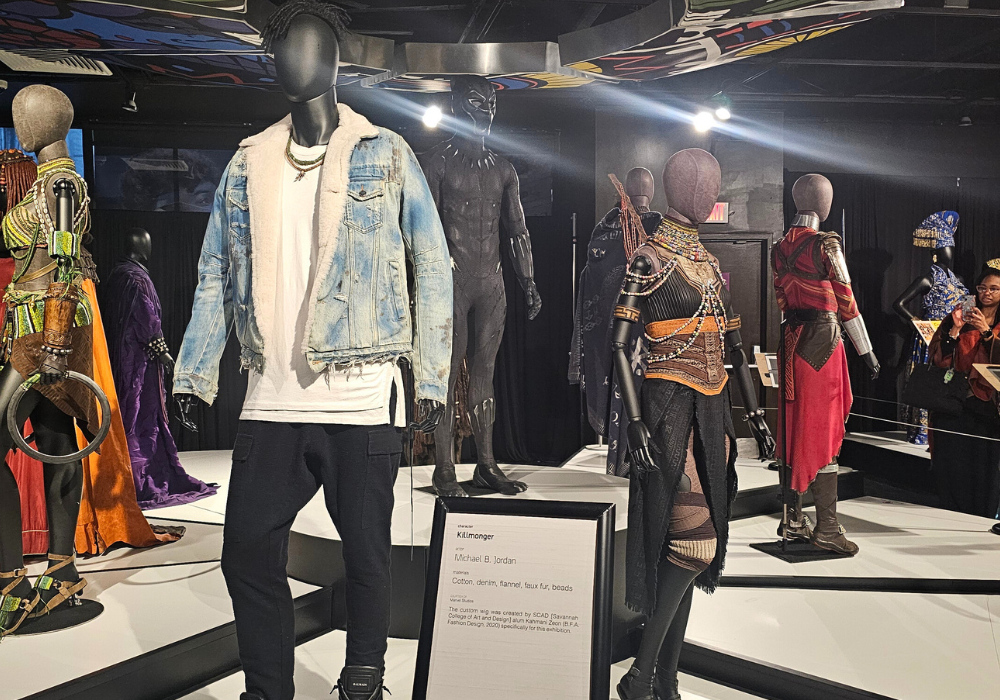
Seeing her work assembled in one space — from Malcolm X to Black Panther to Wakanda Forever — felt like walking through a living archive of Black imagination. I lingered longer than I expected. I circled garments twice. I leaned in close to beadwork and stitching as if proximity might reveal some secret code.
The Dora Milaje armor stopped me cold.
On screen, those costumes communicate strength. In person, they communicate intention. The precision. The layering. The way traditional African influences are not borrowed but honored — elevated — fused with futuristic silhouettes that refuse to apologize for scale or boldness.
It struck me that Afrofuturism, at its core, is an act of defiance.
To imagine Black people not just surviving the future but shaping it. Governing it. Leading it. Adorning it in gold and crimson and indigo. Carter’s work doesn’t ask for permission to exist in grandeur. It assumes it.
And that assumption moved me.
As a Black woman who has spent much of her life being “the strong one,” the competent one, the reliable one — rarely the adorned one — standing before those garments felt personal. These costumes were not about fragility. They were about sovereignty. About beauty without diminishment.
There were sketches displayed beside finished pieces — pencil lines that eventually became cinematic mythology. I found myself drawn to those almost more than the finished garments. There is something comforting about seeing the beginning of brilliance. It reminds you that even the most iconic work starts as an idea on paper.
Afrofuturism often gets flattened into an aesthetic — metallics, braids, armor, bold silhouettes. But in this exhibit, it felt spiritual. Carter’s work insists that Black history and Black future are not opposites. They are braided together.
In the section featuring Wakanda Forever, what struck me most was the evolution. The silhouettes felt sharper, more architectural — grief translated not into softness, but into resolve. The detailing was meticulous, almost meditative, as if every seam carried intention. Standing there, I realized how Carter uses costume to chart emotional terrain. These weren’t just garments marking a sequel; they reflected transition, legacy, and the quiet recalibration of power.
I thought about how often Black creativity reshapes global culture — and how rarely we pause to sit inside that brilliance without rushing past it.
The museum did something important by centering Carter not just as a designer, but as a storyteller. Her costumes do narrative work. They expand archetypes. They disrupt limitation. They make space.
Walking through the exhibit, I kept thinking about taste — about how what we are drawn to is never accidental. I am drawn to work that honors lineage while insisting on evolution. Carter’s work does both.
And if I’m honest, there was something healing about it.
In a world that often narrows Black women into practicality — caretakers, problem-solvers, survivors — these garments offered another vision: warriors, queens, innovators, myth-makers.
Adornment as power.
Imagination as inheritance.
I left the African American Museum in Philadelphia changed in a small but meaningful way. The sky outside felt brighter. The ordinary felt less fixed. I found myself thinking: What would it mean to design my life with that same audacity? To assume scale? To assume grandeur? To honor history while building forward?
This week, I loved Ruth E. Carter’s Afrofuturism not because it was beautiful — though it was breathtaking — but because it was expansive.
And expansiveness, especially for us, is revolutionary.